



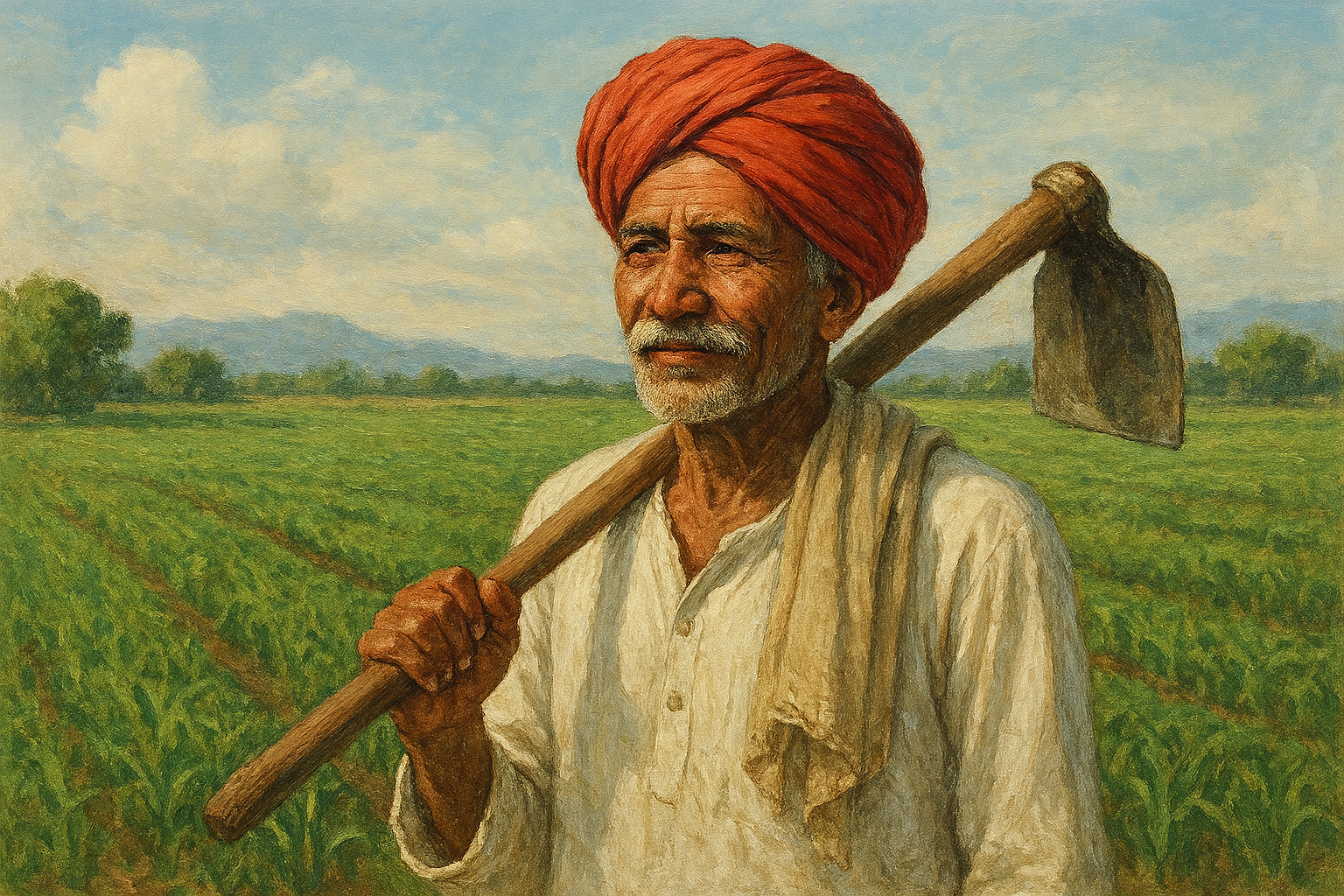
The Seeds of Tomorrow
The Land of Silent Prayers
The land of Mewar was a land of colours baked under the sun. In summer, its rocky hills shimmered like molten brass. In winter, the nights burned with a cold that crept into bones. And yet, despite the harshness, something about this ancient land felt sacred — as if every stone carried a memory, every gust of wind recited an old ballad, and every patch of cracked soil was an unsaid prayer waiting to be answered.
The village of Bhairavpur, tucked between low ridges of the Aravalli range, was the kind of place you didn’t find on maps but remembered once you’d seen it. Its narrow lanes twisted like dried riverbeds, flanked by walls coated with lime and cow dung plaster. The smell of smoke from chulhas mixed with the scent of bajra rotis. Camels groaned lazily at the chowk, their shadows long and unhurried.
And at the heart of this village lived the soil — red-brown, gritty, tired yet stubborn — the kind of soil that demanded respect before it returned a harvest.
Rajveer Singh had grown up believing this soil was alive.
His father used to say, “Dharti maa rooth jaye toh saal bhar ghar mein andhera ho jaata hai.”
Even as a child, Rajveer felt the truth of those words.
His earliest memories were not of toys or festivals, but of mornings when the sun rose over the hills like an orange fireball. His father, Bhairon Singh, would be out in the fields even before the sky lightened, his silhouette moving against the pale horizon, bullocks trudging beside him. The whistle of his father’s tune — an old vigour-filled melody — reached their mud house before he did.
Rajveer would run barefoot over the cool courtyard floor to join him. The stones were cold in the early hours, and the smell of night-blooming jasmine still lingered in the air.
“Aaj jaldi uth gaye?” his father would laugh, tightening the rope around the bullock’s yoke.
Rajveer nodded proudly. “Bapu, I want to plough with you.”
Bhairon lifted him effortlessly, placing him on the wooden plough.“The land is gentler at dawn. Feel her. She listens then.”
The boy would dig his fingers into the softening soil, marvelling at its texture — warm yet grainy, rough yet strangely comforting. The bullocks moved in slow rhythm, their bells chiming softly, and little Rajveer felt like the fields were carrying him forward.
Behind them, his mother Sushila ran the stone chakki, her bracelets clinking like quiet applause. She often sang folk songs from Mewar — songs of heroic warriors, monsoon lovers, and land that fed its people even when it cracked with thirst.
The village lived by these songs. They were reminders of who they were, what they’d endured, and what they must never forget.
Life in Bhairavpur moved at its own pace — slower than the world beyond the hills, but richer in detail.
Old men gathered under the banyan tree, debating politics they didn’t fully trust and drinking chaas from earthen pots. Women queued at the village stepwell, their ghagras swaying like colourful waves. Children ran with tyre rings, their laughter echoing through the lanes.
At dusk, when the sun dissolved into red-orange hues behind the Aravallis, the whole village glowed as though lit by memory. Clay lamps flickered at doorsteps. Cowbells clanged. Someone’s radio played Rajasthani folk tunes, and even the wind seemed to sway in rhythm.
Every evening, a temple bell rang thrice — slow, deliberate, ancient.
It was said that the bell had been cast centuries ago to honour a forgotten deity who protected the crops.
For Rajveer, that bell was the heart of Bhairavpur.
But even the strongest heart can falter.
Years later, when Rajveer was twenty-two, the bell rang without rhythm. It rang for sorrow. His father lay on a charpoy, breath shallow, eyes distant. A fever had gripped him during the monsoon — a fever that refused to break. The rain outside was relentless that night, the roof dripping steadily into buckets. Lightning cracked through the sky, illuminating the worry on Sushila’s face.
Rajveer held his father’s hand.
“Bapu, hold on…”His voice trembled like the flame of a diya in a storm.
Bhairon looked at him and smiled faintly — a smile that carried both love and resignation. “Take care of the land… she remembers your every step. Don’t let her die.”
Those were his last words.
The next morning, the village gathered for the cremation. Smoke spiralled into the sky, joining the rain clouds. The bullocks stood silently near the field, as if mourning.
And in that moment, the land of Bhairavpur felt emptier than ever before.
A week after the rituals, as the family tried to find their footing again, Lala Ramdas, the moneylender, arrived. His footsteps echoed on the courtyard floor — slow, heavy, deliberate.
He wore a spotless white dhoti, carried a thick ledger, and chewed paan with an air of ownership.
“Your father borrowed fifty thousand,” he declared, opening the ledger.
“With interest… eighty-five thousand.”
Eighty-five thousand!!!
The words felt like stones dropping into Rajveer’s stomach.
“But the harvest failed,” he whispered.
Ramdas shrugged, “Failures do not erase debts, beta. The land doesn’t care. Neither do I.”
Meera stood behind Rajveer, her dupatta pulled low in discomfort.“We will pay,” she said softly. “Even if it takes years.”
Ramdas smiled — the kind of smile people wear when they know you’re trapped.
Meera had married into Rajveer’s family three years ago. She came from a village across the hills — quiet, soft-spoken, with eyes that absorbed everything like monsoon soil. Her presence brought calm into their home.
But marriage to a farmer meant her beauty often hid behind sweat, her bangles behind rolled-up sleeves, her dreams behind survival.
Still, she stood by Rajveer through every storm.
When the debts mounted… When the crops failed… When the monsoon betrayed them… When hunger knocked gently but persistently on their door… She stayed.
Her strength was the kind that didn’t shout. It held.
Aarav, their son, was ten — intelligent, curious, hungry for a life beyond ploughs and debt. He loved reading science textbooks he borrowed from the schoolteacher.
“One day, I’ll build machines that can talk to the soil, Papa.”
Kavya, only seven, loved colours. She drew butterflies on the walls with chalk, sang folk songs in a high, sweet voice, and asked questions no one was ready to answer.
“Why doesn’t rain come when we call it?
Why do farmers cry sometimes?
Why doesn’t the earth get tired of holding us?”
Rajveer never had answers. He only had hope — and even that was fading.
The year everything changed forever, the sky played a cruel game.
In June, the clouds disappeared completely. The sun scorched the earth until the cracked soil looked like parched lips begging for a drop of water. Seeds refused to sprout. Birds searched for shade under thorny khejri trees. The smell of dust replaced the smell of hope.
And then in July — when the farmers had almost given up — the heavens opened.
Not gently.
Not slowly.
But violently.
Thunder roared like an angry drum. Sheets of rain slammed into the fields, filling them with muddy water. Rajveer’s newly sown bajra drowned before it even had a chance to rise.
He stood knee-deep in water, helpless.
“Bas… ab kya bacha?” he murmured. “What remains now?”
But the sky offered no answer.
When Rajveer reached the mandi with his damaged crop, the traders barely looked at him.
“Three rupees per kilo.”
The trader flicked a fly off his counter.
“It cost me five to grow, saab.”
“Take it or leave it.”
Rajveer took it. Pride did not fill stomachs.
Back home, Meera cooked thin khichdi — a single spoon of rice stretched with water.
Aarav stared at his book. “Papa… if I become an engineer, will we be rich?”
“Rich in knowledge,” Rajveer said softly. “But never forget where you came from.”
Kavya asked, “Why don’t we leave the village?”
Meera replied before Rajveer could speak:“Because this land is part of us. And we don’t abandon family.”
But even she didn’t sound convinced anymore.
That night, under the neem tree where his father once sat, Rajveer stared at the stars. The breeze carried the faint smell of wet dust. The fields stretched before him, broken, defeated.
“Farming used to be worship,” he whispered. “Now it feels like punishment.”
His voice cracked.
“Bapu… why did you leave so much behind? Why didn’t you tell me how heavy this life becomes?”
He didn’t expect an answer. But he felt one — in the stillness, in the soil, in the memory of the man who lived and died for this land.
Somewhere deep inside, a spark flickered.
The spark of a story that was not yet over.
“When Hope Arrives in Dusty Shoes”
The days that followed felt like an enemy siege.
Heat settled on Bhairavpur like a curse. By afternoon, the air turned glassy, shimmering above the ground like a cruel illusion. The soil cracked open as if thirst had split its skin. Cows gathered near the last muddy waterhole, ribs showing, tongues lolling. Even the wind refused to move. It would rise in tiny gusts and then fall dead, breathless, defeated.
The village well sank lower every morning. Women would crowd at dawn, their brass pots shining like small suns. They lowered their ropes lovingly, cautiously, as if coaxing the last drops with a prayer.
One morning, Rajveer watched Meera pull up her pot. There was barely a handful of water inside.
She sighed — not loudly, not dramatically — but in the quiet way someone sighs when they have learned to negotiate with pain.
When she placed her pot on the verandah, Rajveer approached.
“Meera… I will go early tomorrow. Let me stand in line.”
She shook her head gently. “Aap kheton mein itna kaam karte ho, Rajveer. Let me carry some burden too.”
But her face told a deeper truth. This was her battle. Water for the home — that was a woman’s domain in Bhairavpur. No matter how harsh the world became. She was fighting her own war for dignity.
The village temple, perched on a small mound overlooking the fields, had become the gathering point for desperation. Every evening, people walked barefoot up the dusty slope carrying small plates of marigolds, incense, and hope.
Panditji rang the brass bell so hard that its echo trembled in the very bones of the hills.
“Indra dev, kripaa karo…” Have mercy, Rain God.
Men stood with folded hands. Women whispered so softly that only the gods could hear. Children stared at the sky, waiting for a cloud to appear like magic.
But the sky stayed empty — a pale, merciless blue.
One evening, two neighbours, Himmat and Ramesh, sat on overturned buckets outside the temple gate, discussing the future in voices low enough to hide fear.
“I’m leaving next month,” Himmat said. “Going to Ahmedabad. Heard they’re hiring factory workers.”
“Factory work? You, a farmer?” Ramesh scoffed.
“What farmer? I haven’t grown a full crop in three years.”
Rajveer overheard them as he approached the temple stairs. The words stung him more than he expected.
Himmat leaving felt like a sign. A sign that the land was losing its children.
That Bhairavpur was beginning to unravel.
He joined the crowd inside the temple. The air smelled of camphor, sweat, and the incense of broken hopes. Panditji chanted with growing urgency, but the gods remained silent. When the prayers ended, Rajveer stood outside for a long time, staring at the barren fields. The land of kings, warriors, and centuries of pride — now begging for mercy.
Three days later, on a particularly hot afternoon, a dusty government jeep rattled into Bhairavpur. Its arrival sent a small wave of curiosity through the village. Children chased behind it. Old men raised their heads from their charpoys. Dogs barked lazily.
The jeep stopped near the banyan tree, where the panchayat often met.A young man stepped out.
He wore jeans that had seen too many fields, a khadi shirt slightly wrinkled from travel, and spectacles that made him look more teacher than officer. His shoes were dusty, as if he’d walked kilometers before arriving.
He was smiling — not a polite smile, not a government-officer smile — but the smile of someone who believed he could help.
“Namaste!” he called out enthusiastically. “I’m Arvind Mehta, agricultural development officer for the region. I’m here to speak with the farmers.”
The men around the banyan tree exchanged confused looks.
Government officers rarely came with smiles. And they never came with hope.
Old Govind Kaka muttered, “Let’s see what new scheme they’ve brought to trap us.”
But Rajveer watched Arvind curiously. There was something different about him. He didn’t stand like a man on duty. He stood like someone who cared.
By evening, a small group had gathered under the sprawling banyan, its roots hanging like thick brown ropes. The tree had seen generations come and go. It had witnessed weddings, fights, festivals, and funerals. And now, it witnessed uncertainty.
Arvind opened his file, but before he spoke, he looked at each farmer — really looked at them.
The hollow cheeks. The sunburnt skin. The heavy silence of men who had suffered too much. He closed the file again.
“Let me speak without paper,” he said gently. “These days, farming feels like a punishment to all of you. I understand.”
A murmur spread among the men. No officer had ever started this way.
Arvind continued, “But the world of agriculture is changing. And you can change with it. You don’t need to depend on chemical companies. You don’t need to fear middlemen. You don’t need rain gods to pity you.”
Someone scoffed, “Then what do we need, saab? Magic?”
Arvind smiled. “No. Not magic. Science. Unity. And trust in nature’s rhythm.”
That sentence hung in the air like a spark.
Arvind took a stick and began drawing in the dirt.
“Your soil is sick,” he said. “Chemical fertilisers have weakened it. Pesticides have killed the good insects. Water is disappearing faster than ever.”
He paused. The farmers looked uneasy.
Then he said something no one expected:“But you can heal it. Without spending money.”
“How?” asked Ramesh, frowning.
“With compost. Vermiculture. Mulching. Drip irrigation. Crop rotation.”
The men looked at one another, half-confused, half-interested.
Arvind spoke passionately, hands moving as if sculpting his ideas in the air.
“You’ve been taught that farming means throwing chemicals into the soil. But farming actually means understanding the soil. Feeding it. Respecting it. Everything you need is already here — cow dung, crop residue, neem leaves, earthworms, even the weeds you throw away.”
They stared, stunned. No officer had ever spoken as if farming was art.
Arvind wiped his brow and continued, “Let me show you what happens when you give the land what it truly needs.”
As Arvind described experiments, natural pesticides, and direct-selling models, Rajveer leaned forward, eyes focused.
His heart was pounding. Not in fear… but in recognition. Everything Arvind said echoed his father’s teachings.
“Feed the land, and she will feed you.” “Respect her rhythms, beta.” “Never force her.”
For the first time in years, Rajveer felt a shift inside him — a memory turning into possibility. When the meeting ended and the crowd dispersed, scepticism floated in the air.
Some men muttered, “Naye zamane ka bacha hai… don’t trust him.” Others laughed, “Organic? What are we — mall owners?” Some simply ignored him.
But Rajveer stayed back. He approached Arvind slowly.
“Sir… you said the soil can heal. Can it really?”
Arvind smiled softly. “Yes. The land remembers every pain — but it also remembers every act of care.”
The words struck Rajveer like a forgotten prayer. He invited Arvind home for chai.
Meera brought out steel glasses filled with frothy chai, placing them beside a plate of bajra biscuits. Arvind thanked her warmly — a gesture she wasn’t used to from officers.
He spoke for over an hour. How vermicompost worked? How organic waste could nourish soil? How neem and cow urine made powerful natural pesticides? How farmers could skip the middlemen by selling directly to nearby towns.? How small changes could lead to big revolutions?
The house felt brighter as he spoke. Aarav listened from the doorway, curious. Kavya peeked from behind Meera’s sari.
Arvind noticed them and laughed. “Your kids are listening better than the farmers.” Rajveer chuckled, feeling something he hadn’t felt in months — warmth. When Arvind left, the evening light softened across the fields.
And Meera said quietly, “He speaks like someone who has seen both failure and hope.”
Rajveer nodded. “Maybe both are necessary.”
That night, he didn’t sit under the neem tree wondering why life was hard. He sat imagining possibilities.
The next morning, he made a decision that felt both terrifying and sacred. He would convert one acre to organic farming.
Just one acre. One chance at redemption. Neighbours mocked him.
“Pagal ho gaye ho, Rajveer.”
“You won’t get half the yield!”
“You’ll regret this.”
He ignored them.
For days, he worked late into the evening, preparing the soil by hand. He dug compost pits. He gathered cow dung and dry leaves. He sprinkled neem-based pesticide he made himself using Meera’s old grinder.
Aarav helped him collect earthworms from the damp corners of the fields. Kavya carried small buckets of compost like a proud helper. Meera brought water from the well twice as often. It became their family experiment.
And the soil responded. Shoots appeared. Green returned where brown had dominated. The plants grew slower — but stronger. Rajveer watched them with the same affection he once reserved for his father’s teachings.
When the crop was ready, he harvested the vegetables and carried them to the weekly haat. His basket was smaller than usual, but he walked with a strange confidence.
A woman in her sixties picked up a tomato from his stall. She held it to her nose and inhaled sharply. “Tch! This smells like my childhood,” she said.
Her eyes softened. Her voice trembled. “Young man, give me two kilos.”
Another man tasted a cucumber slice. “One more. I want more.”
Rajveer sold everything in under an hour — at double the normal price.
When he returned home, Meera saw a smile on his face she hadn’t seen in years.
“What happened?”
Rajveer placed the earnings in her hands. “People tasted their memories today.”
She touched his cheek gently. “And did you taste yours?”
He nodded, eyes moist. “Yes.”
That night, as the family ate dinner, Rajveer said softly:“Meera… maybe this is the beginning. Maybe the land hasn’t given up on us yet.”
She smiled. “It never did, Rajveer. We were the ones who stopped listening.”
Outside, the wind shifted for the first time in weeks. A cool breeze swept across the fields, carrying the scent of night-blooming flowers. And somewhere in the dark, a seed — tiny, fragile, hopeful — broke open. Not in the soil. But in Rajveer’s heart.
“When the Village Stands Together”
News of Rajveer’s “strange new farming” spread through Bhairavpur like afternoon gossip. Some farmers watched from a distance, arms folded. Some shook their heads at his compost pits and homemade sprays. Some whispered that he had gone mad after his father’s death. Some said Meera must have pressured him — because who else would dare disturb tradition? But amidst the ridicule, a few watched with quiet hope.
One of them was Himmat, the same man who had once thought of leaving for Ahmedabad. He approached Rajveer cautiously one morning as he watered his plants with a bamboo pipe.
“Bhai… is this really working? Or are you just pretending to be brave?” Rajveer laughed softly. “Nothing to pretend. You saw my vegetables in the haat.” Himmat nodded, scratching his chin.
“My wife keeps saying your lauki had the taste my mother used to talk about. She thinks you’ve done some jadoo.”
“The only magic,” Rajveer replied, “is the land finally breathing again.”
There was silence. A breeze passed through the khejri trees, rustling dry leaves like whispers.
“Rajveer…” Himmat hesitated. “Can you help me try this on half an acre?”
Rajveer smiled, his heart swelling a little.
“Yes, brother. The land belongs to all. Why should knowledge not?”
It was the first crack in the wall of resistance.
Within a month, others began approaching him. Ramesh came next, then Govind’s nephew, then an old man named Jodhraj who had sworn never to change his methods. Each for a different reason: Himmat hoped to save his failing crops. Ramesh was tired of chemicals burning his skin. Jodhraj wanted to reduce his expenses. Govind’s nephew was simply impressed by Aarav’s homemade app.
The soil, it seemed, had started whispering to many.
So one evening, Rajveer called a gathering under the banyan tree — the same place where Arvind had first planted the seed of change.
The sun was setting behind Bhairavpur, painting the sky orange and purple. Women passed carrying metal pots on their heads. Buffaloes trudged home, bellies dusty, eyes glowing like small lamps. Kids climbed the roots of the banyan tree, swinging like monkeys as the meeting began.
Rajveer cleared his throat. “Brothers… sisters… we all know farming alone is becoming impossible.”
A few murmurs of agreement. A few sceptical nods.
“Water is less. Costs are rising. Middlemen eat our profit. If we are to survive, we must stand together.”
Himmat whispered, “Speak louder, Rajveer. You sound like Panditji reciting quietly.”
A ripple of laughter broke the tension.
Rajveer continued, voice firm now. “What if we formed a group — a collective — where we buy seeds together, sell crops together, share tools, share knowledge, share problems?”
Govind Kaka grumbled, “Collectives fail. I’ve seen it before. People fight.”
“People fight when they are desperate,” Rajveer replied. “But when they share hope, they stand stronger.”
The crowd fell silent. Even the kids stopped climbing. Rajveer added, “Call it whatever you like. Sangh, group, union… but let’s make something that will feed our families with honour.”
Himmat raised his hand like a schoolboy. “We should call it Jeevan Dhaara — the flow of life.”
Everyone murmured approval. The name felt pure. Rooted. Hopeful.
That night, under the banyan tree, with a lantern flickering between them, ten farmers touched a steel lota filled with well water and took an oath:
“We stand together. We farm together. We rise together.”
The banyan leaves rustled softly as if blessing the beginning of a revolution.
The next few weeks felt like a wedding in the village — chaotic, loud, messy, but filled with purpose. Everyone contributed something. Himmat’s cousin arranged a truck on discount. Rajveer provided compost training. Ramesh, who had once sold vegetables in the city, suggested markets in Udaipur where organic produce fetched triple the price. Govind Kaka’s son created a makeshift storage shed using leftover bricks and tin sheets.
But the most surprising contribution came from the children. Aarav, in his brilliance, improved his homemade mandi-price app. It now showed real-time price updates from three nearby mandis. When he demonstrated it to the farmers, Ramesh clapped him on the back. “Beta, with this app, I won’t let even a single trader cheat me again.” Aarav beamed.
Kavya, meanwhile, gathered her friends and painted colourful flyers:
“Chemical-Free Vegetables from Bhairavpur!”
“Healthy Mewar Produce — Direct From Farmers!”
“Tastes Like Your Grandmother’s Kitchen!”
She hung them in nearby villages, panchayats, shops, and even near the school. Villagers smiled when they saw the flyers. Some even asked: “Are these the vegetables grown by that singh-saab with a smart son and a brave wife?”
Bhairavpur had started to speak in the language of pride again.
One of the first big steps of the collective was to host a workshop for farmers — something unheard of in the village.
Arvind, the agricultural officer, agreed to help. When he returned, covered in dust, he laughed, “It feels like I never left.”
The workshop was held at the community ground. The villagers set up shamianas with bright red cloth, and women cooked dal-bati for everyone.
Farmers gathered from neighbouring villages — some curious, some doubtful.
Arvind spoke about soil health.
A retired professor demonstrated composting.
A young woman from an NGO explained water-conservation techniques.
A tech student introduced low-cost sensors that could measure soil moisture.
The crowd gasped at each demonstration. Rajveer watched from the side, a smile creeping across his face. He felt the future walking toward Bhairavpur — one step at a time.
At the end of the workshop, a shy boy approached Rajveer. “Uncle… will farming look like this when I grow up?”
Rajveer ruffled his hair. “Yes. And even better. You will make it better.”
But life, like the Mewar sky, changes moods quickly. Just when everything looked promising — when the first organic crops were being prepared for a larger harvest — the winds shifted again. One evening, Govind Kaka rushed to Rajveer’s house, panting heavily.
“Rajveer! The water in the main well… it’s dropped again. More than we expected.”
Rajveer frowned. “That is impossible. Last monsoon, the recharge was good.”
Govind shook his head. “Not good enough. And someone has been illegally drawing water at night.”
Rajveer’s heart tightened. “Who?”
Govind hesitated. “Lala Ramdas.”
Rajveer felt a surge of anger rise inside him. Ramdas — the moneylender. The man who had been waiting years to swallow the land of those who couldn’t repay him.
“Is he using pumps?” Rajveer asked. Govind nodded grimly. “At night. Without permission. He’s drawing water like it belongs to him.”
The collective’s heartbeat trembled. Without water, everything — compost, seeds, hope — would crumble.
The farmers met at the banyan tree again, flames of lanterns flickering wildly in the wind. “Should we confront him?” Himmat asked, fists clenched. “No,” Ramesh said. “He will twist the law against us.” “We must catch him in the act,” Rajveer said slowly. So at midnight, a group of six farmers walked towards the main village well. The path was silent except for the chirping of crickets. The moon painted the fields silver-blue. The air smelled of dust and impending trouble.
As they neared the well, they heard it:
The growl of a diesel pump.
Water being sucked violently through thick pipes. Footsteps. Voices. Laughter.
Ramdas’s men. They hid behind a rock pile. Within moments, they saw them — two labourers holding torches, and one man operating the illegal pump. The water poured into a tanker owned by Ramdas.
Himmat whispered angrily, “This is theft!” Rajveer grabbed his arm. “Not yet. Let’s gather proof.”
He took out his old phone — a cheap model with a shaky camera — and recorded everything.The pump. The tanker. The men.
When they returned, the village waited anxiously.
“Did you find anything?” Meera asked, worry etched on her face.
Rajveer nodded. “Yes. We found the truth.”
He held up his phone. “Tomorrow, we confront him — with evidence.”
The next morning, the village gathered in the panchayat courtyard. Ramdas arrived in his pristine white dhoti, chewing paan as always, arrogance sitting like a crown on his head.
“What is the matter?” he asked lazily.
Govind spoke first. “You have been stealing water from the main well.”
Ramdas laughed. “Stealing? Please. Don’t throw accusations at me. Do you have proof?”
Rajveer stepped forward. “Yes.”
He played the video on his phone. The entire courtyard watched. Gasps. Whispers. Shock.
Ramdas’s face darkened. “This proves nothing! Anyone could have shot this to frame me!”
But his voice lacked its usual confidence.
The sarpanch looked at him. “Ramdas… you have broken the law. The well belongs to the village. This cannot continue.”
Ramdas glared at Rajveer, hatred simmering.
“This is not over,” he said quietly. “You think you’re a hero? You think these people will stand with you forever? Farmers are fickle. Hope breaks. And when it breaks, I’ll be waiting.” He stormed out.
Silence fell.
Then the sarpanch turned to Rajveer. “You did the right thing. The collective saved our water.” A ripple of pride spread through the crowd. But Rajveer felt a chill run through him. Ramdas had power. And now, he had anger.
Two dangerous things.
For a few weeks, peace returned — fragile, like the first green leaf after winter. But nature had its own plans. By mid-September, the rains that were predicted never came. Clouds drifted across the sky but refused to open. The fields dried faster than they could be watered. New seedlings wilted within days. The collective’s beautiful dream began to crack.
One evening, Ramesh threw his dry crop onto the ground. “This organic farming is a curse! At least chemicals worked in drought!”
“Don’t say that,” Himmat snapped. Rajveer intervened, “Brothers! Don’t fight—”
“What don’t fight?” Ramesh shouted. “Our families are hungry! You said unity will save us — but unity doesn’t bring rain!”
Some farmers looked away. Some nodded helplessly. Some held tears in their eyes. Rajveer felt his chest tighten. He had brought them hope. Was he now bringing them ruin? The drought stretched on. Farmer after farmer returned to desperation. The soil cracked deeper. The cattle grew weaker. The well dropped to its knees.
One night, Rajveer sat with Meera in their dim courtyard. She placed her hand on his. “Rajveer… even the bravest man needs rest. Don’t let this break you.”
He looked at her, eyes burning. “I told them dreams are possible. And now the land is killing those dreams.”
She whispered, “Then dream again. Dream harder. Dream smarter. But don’t stop dreaming.” He looked out at the dry fields — a battlefield of broken hope.
And in that darkness, he realized: The real drought was not in the soil. It was in the spirit. And that was the drought he had to fight.
“The Storm That Came From Within”
The drought stayed far longer than anyone expected. Every sunrise felt like a warning. Every sunset felt like defeat. By October, even the oldest farmers began losing hope — the kind of hope that had carried Mewar through centuries of droughts and wars. The wells of Bhairavpur whispered of emptiness. The air carried dust instead of the smell of soil. Even the birds flew lower, searching for water in abandoned pots or the shadows of trees. The collective, once full of energy and laughter, now carried the heaviness of a broken promise.
Whispered doubts turned into loud arguments. Arguments turned into accusations. Accusations turned into cracks. Rajveer felt each crack like a wound.
One afternoon, under the scorching sun, a heated argument erupted in the storage shed. Ramesh threw a bundle of dried crop on the ground. “Enough! This was a mistake. We should never have followed this man’s ideas!” He pointed at Rajveer. Himmat stepped forward. “Don’t blame him for nature’s cruelty. We are all suffering—”
“Suffering?” Ramesh shouted. “Some of us barely have food for the week. My wife sold her gold bangles for seeds — and look what happened! Nothing but dust!”
Rajveer stood silently, swallowing guilt like bitter medicine. Ramesh continued, tears streaming down his cheeks now. “You promised us something better, Rajveer. You said nature will help us. You said unity will save us.”
“And it still will,” Himmat argued desperately. “We must wait—”
“Wait for what?” Ramesh cried. “For our children to starve?” His voice broke. The entire shed fell silent. Only the wind spoke — dry, hollow, almost mocking.
Then one of the older farmers spoke softly, looking at Rajveer: “Maybe you were wrong, beta. Maybe we were meant to suffer. Some lives are not meant to rise.”
Something inside Rajveer shattered. He felt a deep ache spreading in his chest, an ache rooted not in failure — but in the sense that he had betrayed the people he loved.
He walked away, unable to face their eyes.
Rajveer walked aimlessly through the village outskirts, past dry fields and thorn bushes. The landscape looked like a battlefield — trees standing like soldiers long defeated, soil cracked like ancient wounds. The sky above him was a vast stretch of cruel blue. He reached the old stepwell at the edge of Bhairavpur — a centuries-old baori with crumbling steps. Once, this baori had been the pride of the village. Its deep stone walls echoed with laughter of women fetching water, children splashing their feet, men resting under its shade.
But today, it was nearly dry. Only a shallow puddle remained at the bottom, reflecting the sky like a broken mirror.
Rajveer sank to the stone steps, his body trembling. The weight of the entire village seemed to press against his shoulders.
What have I done? Was it foolish to dream? Did I drag others into my hope — only to drown them?
His eyes burned. For the first time since childhood, he prayed with the desperation of a man drowning.
“Bapu… give me a sign. Tell me I haven’t failed you. Tell me I haven’t failed them.”
His voice cracked, swallowed by the empty well.
But no sign came. Only silence.
By evening, when he finally returned home, Meera saw the defeat etched on his face. His shoulders were slumped, his eyes hollow. He looked like a man who had lost something greater than land — something inside himself. She sat beside him quietly, letting the silence settle between them. Finally, she placed her hand over his. “Tell me,” she whispered.
Rajveer broke.
“They trusted me… and now they are drowning because of my dreams. Maybe Ramdas was right. Maybe farmers are not meant to rise.”
Meera’s voice was soft but firm. “Do you truly believe that?”
He shook his head helplessly. “I don’t know what to believe anymore.”
Meera inhaled deeply, steadying herself before she spoke. “Rajveer, listen to me. You did not ask for drought. You did not ask for storms. But you stood up when everyone was sinking. You gave them hope. That is not failure.”
He looked at her, eyes clouded with pain. “But they are suffering now.”
“And so are you,” she said. “But suffering is not a sign you were wrong. It’s a sign you are trying something new.”
She cupped his face like a mother calming a frightened child. “Rajveer… farmers like you are rare. You fought the land, the sky, the system, and even your own fears. That is strength. Not failure.”
Tears finally spilled from his eyes. Meera wiped them gently. “Don’t give up, Rajveer. The land hasn’t given up on you. And neither have we.”
Her words seeped into him like the first drop of rain on thirsty soil.
Later that night, after dinner, Aarav came and sat beside him. “Papa… do you know what I learned today?”
Rajveer looked at him weakly. “What, beta?”
Aarav opened his school notebook and pointed to a line he had written. “Rain always comes later than we want — but earlier than we fear.”
Rajveer looked at him, confused.
“My science teacher said this when the children were sad about the drought,” Aarav explained. “It means nature has its own timing, Papa. We can’t force it. But we can prepare for it.”
Kavya ran to them, carrying a drawing. She held it proudly. “Papa, look! I drew our farm with green plants and big clouds.”
Rajveer stared at her drawing — green, vibrant, full of life. It felt like a reminder.
Dream again. Even if the world refused to.
That night, after everyone slept, Rajveer stepped outside into the courtyard. The moon hung low, bathing the village in silver. He looked at the dry fields — but tonight, they didn’t look like defeat. They looked like soil waiting for another chance.
Rajveer made a decision. He would fight. One more time. One last time. And not with desperation — but with courage.
He whispered into the wind, “Bapu… I will try again. This time, with everything I have.”
The wind responded with a soft gust, swirling dust around his feet.
It almost felt like approval.
The next morning, something changed. It began with a smell — that unmistakable smell of wet dust but so faint it felt like a memory. Meera noticed it first. “Rajveer… do you smell that?”
He stepped outside. A breeze brushed against his face — cool, heavy, promising. Children in the street began pointing excitedly at the hills. “Clouds! Clouds are coming!”
Neighbours came out of their homes, squinting at the sky. Govind Kaka wiped his glasses. “Haan… clouds toh aa rahe hain. Big ones.” Rajveer felt his heart thump. Within an hour, the sky darkened. Not like a summer evening. Not like a passing shadow. But like a long-awaited blessing.
And then —
Thunder.
A sound so deep, so powerful, it echoed through the entire valley. People stood frozen. As if afraid to blink and lose the moment. Then came a single drop. Then another. Then a hundred. And then — the heavens opened.
Rain.
Beautiful, wild, unstoppable rain. Children screamed with joy. Women laughed and ran to collect water in pots. Cows lifted their heads to the sky. Birds danced in the sudden downpour. Rajveer stood still as the rain soaked him completely.
The sky was crying. The land was crying. And so was he. But these were tears of relief. Of release.
Of rebirth.
Within minutes, the collective farmers rushed toward Rajveer’s house, drenched, laughing, shouting his name. Himmat hugged him tightly. “Bhai! The rain has come! Your faith was not wrong!”
Ramesh — the same Ramesh who had shouted at him — approached slowly. His lips trembled. He folded his hands. “Forgive me, Rajveer. I lost hope. But today… today the sky reminded me who we are.”
Rajveer embraced him. “No forgiveness needed. We all break sometimes.”The collective stood in a circle — drenched, muddy, emotional. Someone shouted, “Jeevan Dhaara Zindabad!” The cry echoed through the village. Followed by another. And another. The rain fell harder. The land began to drink.
And hope, which had almost died, rose up like a new seed bursting through the soil.
The rains brought the fields back to life.The soil softened. Seeds sprouted. Green spread across the landscape like healing. The collective worked side by side — stronger now, bonded by shared suffering. The land responded warmly, lovingly. When the harvest finally came, it was not large — but it was beautiful. Vegetables shone with colour. Grains felt full, rich. The taste… the aroma… everything felt alive. When they loaded the truck for Udaipur that season, the village gathered to watch. It felt like sending their dreams to the world. And the world responded. Their produce sold out in two hours. A newspaper journalist noticed the buzz and wrote an article titled:
“The Farmers Who Fought the Sky — and Won.”
A week later, a district officer called Rajveer.
“Sir, your cooperative has become an example. We want you to speak at a seminar in the city. Will you come?”
Rajveer was stunned.
“Me? Speak?”
“Yes. The farmers need to hear your story.”
That evening, Rajveer told Meera. She smiled wide, tears gathered in her eyes.
“Rajveer… your father must be proud. You kept his soil alive.” He looked at her lovingly.
“No… we did.”
“The Harvest of Hope”
For a man who had rarely left his village, the journey to Udaipur felt unreal. The bus rattled along winding roads carved through the Aravalli hills. The peaks stood like ancient guardians, their silhouettes cutting against the morning light. Dry shrubs, thorny babool, and the occasional peacock dotted the landscape. Rajveer sat by the window, nerves tightening inside him. His red pagdi had been tied by Meera herself. His white kurta smelled of the neem leaves she had packed between the folds. He had brought nothing else with him—no speech, no notes, no special clothes. Only his story.
Beside him sat Arvind, cheerful as always. “I told the organisers about your journey,” Arvind said. “They’re eager to hear you.”
Rajveer swallowed. “Will they understand? I am just a farmer.”
Arvind smiled warmly. “That’s exactly why they will understand.”
The city grew closer—a patchwork of lakes reflecting the sky, white palaces rising like dreams from stone, and roads bustling with a world far larger than Bhairavpur. Rajveer pressed his hand against the bus window, watching the unfamiliar world flash by. His heartbeat felt like the drumbeat of a festival. This was no ordinary journey. It was a crossing—from survival to voice.
The seminar hall was massive—white walls, bright lights, rows of chairs filled with officials, scholars, and young students dressed in crisp clothes. A banner hung above:
“Future of Farming — Voices from the Fields.”
Rajveer’s name was printed beside “Key Speaker.” He stared at it in disbelief.
Arvind whispered, “You earned this.”
When Rajveer was called on stage, he walked with slow, steady steps. His hands trembled slightly. His red pagdi felt heavier than usual, as if carrying the weight of Bhairavpur. He reached the podium and looked out. So many eyes. So many expectations. For a moment, he froze. Then he remembered his father standing in the fields at sunrise. He remembered Meera washing his face before he left. He remembered his children’s drawings, his community’s faith, his own journey from despair to hope. He exhaled deeply.
“Namaste,” he began, voice surprisingly calm. “I am Rajveer Singh… a farmer from Bhairavpur.”
The hall fell silent.
“I did not come here to teach you. I came to tell you what the land taught me. To tell you what hunger taught me. To tell you what hope taught me.”
He spoke slowly, with the honesty of a man who had nothing to hide.
He spoke of drought.
Of debt.
Of humiliation.
Of failure.
Of neighbours leaving the village.
Of the night he prayed at the old stepwell.
Of how one acre changed his life.
Of how unity gave them strength.
Of how the rains returned just when hope had died.
The hall listened not with ears, but with hearts. He ended his speech softly:
“We are not poor because our soil is poor. We are poor because we stopped believing in the soil. Farming is not a gamble. It is a relationship. A prayer. A promise.”
A long silence followed. Then applause—slow, rising, echoing through the hall. Some people stood. Some wiped tears. Students rushed to him afterward.
“Sir, you inspired us!”
“Your words were more powerful than any lecture!”
“We want to visit Bhairavpur!”
Arvind placed a proud hand on Rajveer’s shoulder. “You didn’t just speak,” he whispered. “You awakened something.”
When Rajveer returned to Bhairavpur, the entire village was waiting at the bus stop. Children waved flowers. Women clapped and ululated. Men burst crackers. Someone had painted a banner:
“WELCOME, RAJVEER BHAI — THE PRIDE OF BHAIRAVPUR!”
Himmat ran forward and lifted him in a bear hug. “Bhai! You spoke for us all! I heard on the radio—they mentioned your name!” For the first time in years, the village celebrated a farmer—not a festival, not a wedding, not a victory in a match—but a farmer. Meera wiped tears secretly with her pallu as she walked beside him.
“You spoke beautifully,” she whispered.
Rajveer blushed like a shy boy. “It was the land speaking. Not me.”
She smiled. “Maybe. But the land chose you.”
That night, the collective gathered for a feast under the banyan tree. Laughter echoed. Stories flowed. Children ran barefoot, chasing fireflies. The lanterns cast warm light on faces that had finally learned to smile again. For once, the fields were not the only place where seeds were planted.
Seeds of dignity.
Seeds of belief.
Seeds of future.
Time moved differently after that. The collective grew from ten farmers to thirty. Then fifty. Then to nearly all of Bhairavpur. The once-dry stepwell was restored with government funds. Solar panels dotted the village rooftops. Women started small cottage industries—pickles, papads, handmade spices. And the children? They grew with a fire in their hearts.
Aarav, always the dreamer, pursued his education fiercely. With scholarships and sleepless nights, he completed his degree in agricultural engineering. The day he returned home holding his certificate, the whole village erupted in cheers.
“Beta, now you will teach the land how to speak to us!” Himmat teased. Aarav grinned. “Not teach, Kaka. Listen.”
He installed soil-moisture sensors, designed low-cost water meters, created a digital marketplace for the collective, and trained farmers to use simple mobile tools. Kavya, now a spirited teenager, traveled to nearby villages conducting awareness sessions about climate change, water conservation, and waste recycling.
“Children listen to me,” she would say proudly. “Adults argue. Kids don’t.”
Her laughter carried across fields like a monsoon breeze.
Visitors began coming to Bhairavpur. Students, Scientists, Government officials, Journalists, NGO workers. They saw solar-powered irrigation pumps. They saw compost pits alive with earthworms. They saw crop diversity—bajra, lentils, vegetables, medicinal plants. They saw water channels designed by Aarav. They saw community strength designed by the collective. One day, a filmmaker arrived. He wanted to make a documentary on the village. When his drone flew over the green fields, capturing the golden light of dawn, the village children screamed and ran beneath it, waving wildly.
“Look! We are in the sky!”
Rajveer stood in the field watching the drone rise higher, his heart swelling with pride. The land had been quiet for years. Now, it was singing.
One winter morning, as the fields glowed with golden wheat, Rajveer walked alone through the crops. The air was cold, crisp, carrying the smell of earth that had healed and forgiven. He reached the centre of the field and closed his eyes. He imagined his father standing beside him.
“Bapu… your land survived.”
A soft breeze touched his cheek—gentle, warm. Almost like a blessing.
It was late evening. Rajveer stood at the edge of his farm, watching the sun sink behind the Aravalli hills. The sky was a riot of orange, pink, and gold — the kind of sky that made even silence sound like music. Meera walked toward him, two cups of steaming chai in her hands.
“You always find the most beautiful light,” she said.
Rajveer sipped the chai slowly. “I don’t find the light,” he said softly. “The light finds us… when we keep walking.”
She smiled. Aarav joined them, checking data on his phone.
“Papa, the sensors show perfect moisture levels. And the new crop rotation is working.”
Kavya came running, holding a notebook filled with her sketches of the farm.
“Papa! See what I drew today!”
He looked at the drawing. It showed a farmer standing in a green field, holding a seed to the sky. A giant cloud above him poured rain like blessings.
“When did you make this?” he asked.
“Every day,” she said proudly. “Because every day the land feels happier.”
The four of them stood together — a family that once feared tomorrow, now shaping it.
As the sun dipped behind the hills, a drone from the documentary team buzzed overhead, capturing the scene.
Rajveer didn’t look up. His eyes were fixed on the land.
A land that had broken him.
A land that had healed him.
A land that had taught him resilience.
He whispered to the wind: “Tomorrow… we grow again.”
The wind answered softly, rustling the wheat.
The Soil Remembersx`
Years later, when people spoke of Bhairavpur, they didn’t speak of droughts or debts. They spoke of courage, Of unity, Of transformation. Visitors came from faraway cities to learn from the farmers who had rewritten their destiny. And in the fields, children played among rows of crops—laughing, dreaming, believing. Because now the land held new memories, Memories of a collective that refused to break, Memories of a family that refused to surrender, Memories of a farmer who dared to believe the soil could rise again. The soil remembers everything. And as long as farmers like Rajveer Singh sow seeds of hope—
India will flourish.
Beneath the sun, beneath the rain
Beneath a farmer’s silent pain,
The earth remembers every tread—
The dreams once born, the tears once shed.
For every seed we dare to sow,
A thousand unseen roots will grow;
And even when the skies refuse,
The soil keeps faith in those who choose.
So walk the land with steady heart—
For hope itself is sacred art;
And futures bloom in fields of gold
Where stories brave and true are told.
Top
Back
© 2025 Creatingbig Publishing (OPC) Private Limited.All rights reserved